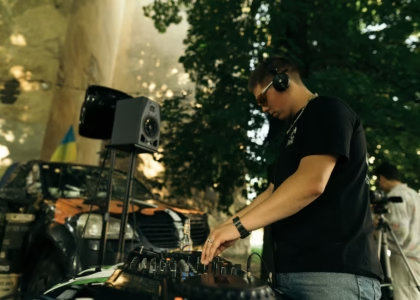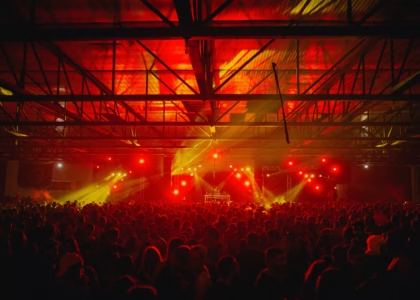

If you have spent any time on YouTube or gaming forums in the last decade, you have likely encountered Hardbass. It usually arrives accompanied by a hyper-specific visual aesthetic: young people clad in matching three-stripe tracksuits, squatting in abandoned industrial parks, dancing aggressively to an incredibly fast, booming electronic beat.
Because of its massive virality and association with internet meme culture (often tied to the Eastern European “Gopnik” subculture), many people mistakenly assume Hardbass is just a massive online joke. In reality, Hardbass is a legitimate, highly influential subgenre of electronic dance music with a rich history.
Originating in the underground rave scenes of Russia in the late 1990s, Hardbass took the intensity of UK Hardcore and the bouncy rhythms of European House and mutated them into something entirely unique. Today, it commands a dedicated global following, filling massive festival arenas and evolving alongside modern digital production techniques.
Whether you are an aspiring electronic music producer trying to understand sound design or simply a curious listener trying to decode the memes, this beginner’s guide breaks down the history, the culture, and the technical anatomy of Hardbass music.
The Origins: Saint Petersburg’s Pumping House
To understand Hardbass, you have to look back to post-Soviet Russia in the late 1990s and early 2000s. As Western electronic music flooded into Eastern Europe, Russian DJs and producers in Saint Petersburg began experimenting with “Pumping House” and “Bouncy Techno”.
DJs like DJ Tolstyak, DJ Rentgen, and XS Project were playing massive, noisy warehouse raves (often at locations like the Mednoe Ozero artificial lake). To raise the energy of the crowds, producers began aggressively increasing the tempo of their tracks, pushing past standard house music tempos and aiming for 150 BPM and above.
As the tempo increased, the sound became harsher and more mechanical. Producers began incorporating distinctive whistle samples, distorted minor-key synth stabs, and aggressive, localized Russian chanting. By the mid-2000s, this abrasive, high-energy offshoot of pumping house had officially solidified into its own distinct genre: Hardbass.
The Anatomy of a Hardbass Track (BPM & Sound Design)
What actually makes a song “Hardbass”? The genre is defined by a very strict set of structural and sonic rules. If you break these elements down in a digital audio workstation (DAW), the DNA of the genre becomes clear.
- The Tempo (150 – 175 BPM): Hardbass is fast. While some early or modern crossover tracks sit around 130 to 140 BPM, traditional Hardbass operates at a relentless 150 to 175 Beats Per Minute. This places it much faster than standard House or Techno, bordering on the speeds of Drum & Bass.
- The “Donk” Bass: This is the absolute defining characteristic of Hardbass. A “donk” is a metallic, hollow, and incredibly bouncy bass sound. It is typically created using FM (Frequency Modulation) synthesis, featuring a sharp, percussive attack that makes it sound almost like a thick metallic pipe being struck.
- The Off-Beat Bounce: Hardbass relies on a “four-on-the-floor” kick drum pattern (a heavy kick on every beat). However, the famous “donk” bass is almost exclusively placed on the off-beat (the spaces directly between the kicks). This creates a violent, pumping, see-saw rhythm that forces the listener to jump or bounce.
- Distorted 909 Kicks: The kick drums are not clean. They are heavily saturated and overdriven, often using classic Roland TR-909 drum machine samples that have been pushed to their absolute limits through digital distortion plugins.
- Chants and Shouts: Vocals in Hardbass are rarely melodic. They are usually aggressive, rhythmic shouts, often delivered in Russian, operating more as an extra percussion instrument than a traditional lead vocal.
The Culture: Gopniks, Tracksuits, and Flash Mobs
You cannot separate Hardbass from its visual subculture. In the 2000s, the genre became deeply associated with the Gopnik subculture—a term used to describe working-class youth in post-Soviet Russia, often stereotyped for wearing Adidas tracksuits, flat caps, and spending time squatting in public spaces.
In the early 2010s, this local subculture exploded onto the global internet through “Hardbass Attacks.” These were organized flash mobs where groups of masked youths would descend upon public spaces (shopping malls, public squares, classrooms) in Eastern Europe, blast Hardbass from portable speakers, perform an aggressive, synchronized stomping dance for a few minutes, and quickly disperse.
When these videos hit YouTube, the combination of the aggressive music and the bizarre, chaotic dancing went viral. It was quickly adopted by internet meme culture, gamer communities (particularly surrounding games like S.T.A.L.K.E.R. and Counter-Strike), and creators like Life of Boris, catapulting the genre to an international audience.
Key Artists and Essential Listening
If you want to dive into the genre, these producers and groups represent both the historical foundation and the modern, internet-savvy evolution of Hardbass:
- XS Project: Absolute pioneers of the genre from Saint Petersburg. Their track “Bochka, Bass, Kolbaser” is widely considered one of the foundational anthems of Hardbass.
- Hard Bass School: Another legendary Saint Petersburg duo that helped define the classic sound and maintain its popularity through the 2010s.
- DJ Blyatman: A modern producer who perfectly bridges the gap between high-quality electronic production and internet meme culture, often collaborating with popular YouTubers.
- Alan Aztec: Known for pushing the genre into new, colorful territories by mixing Hardbass with elements of Gabber and high-tempo hardstyle.
- Russian Village Boys: A contemporary group that brings a punk-rock energy to electronic music, releasing heavily focused Hardbass and Gabber tracks that dominate modern European rave scenes.
Genre Comparison: Hardbass vs. Hardstyle vs. Gabber
Because Hardbass operates at such a high tempo, it is frequently confused with other “Hard Dance” electronic genres. Here is how they differ structurally:
| Feature | Hardbass | Hardstyle | Gabber (Hardcore) |
| Typical BPM | 150 – 175 BPM | 150 – 160 BPM | 160 – 200+ BPM |
| Signature Bass | The bouncy, metallic “Donk” placed on the off-beat. | A heavily distorted, pitched “Gong” or “Tok” that tails off. | Extremely distorted, sustained bass that blurs with the kick. |
| Melody Style | Terse, repetitive synth stabs and minor-key riffs. | Grand, euphoric, and complex stadium-sized melodies. | Dark, aggressive, and often abrasive or dissonant. |
| Overall Vibe | Bouncy, playful, aggressive, and highly danceable. | Epic, emotional, and theatrical. | Relentless, violent, and physically exhausting. |
Frequently Asked Questions (FAQ)
Understanding the Hardbass Genre
Is Hardbass considered a “real” music genre or just a meme?
It is absolutely a real, officially recognized subgenre of electronic dance music. While internet meme culture massively boosted its global visibility in the 2010s, Hardbass existed as a legitimate underground rave scene with dedicated producers, labels, and clubs for a full decade before the internet discovered it.
What does the term “Donk” mean in electronic music?
A “donk” refers to a specific type of bass synthesizer patch. It is a short, highly percussive, hollow sound—often described as sounding like a wet PVC pipe being hit with a rubber mallet. It is the defining rhythmic instrument of Hardbass and UK Scouse House.
Why is Hardbass associated with the Adidas brand?
The association stems from the post-Soviet Gopnik culture. In the 1980s and 90s, imported Western tracksuits (especially Adidas, popularized by the 1980 Moscow Olympics) became highly sought-after status symbols in Eastern Europe. The working-class youth who drove the early Hardbass scene adopted the tracksuit as their unofficial uniform, cementing the visual aesthetic forever.
Hardbass is a fascinating case study in how music evolves. What began as a localized, aggressive offshoot of house music in the freezing warehouses of late-90s Saint Petersburg eventually conquered the global internet. While it is easy to get distracted by the tracksuits, the squatting, and the viral memes, underneath the jokes lies a tightly engineered, high-BPM electronic genre built on ruthless sound design and undeniable, infectious energy.
Whether it is pumping through a festival sound system or serving as the soundtrack to a viral gaming video, the bouncing “donk” of Hardbass remains one of the most instantly recognizable sounds in modern electronic music.