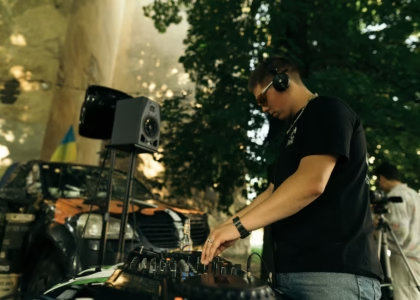
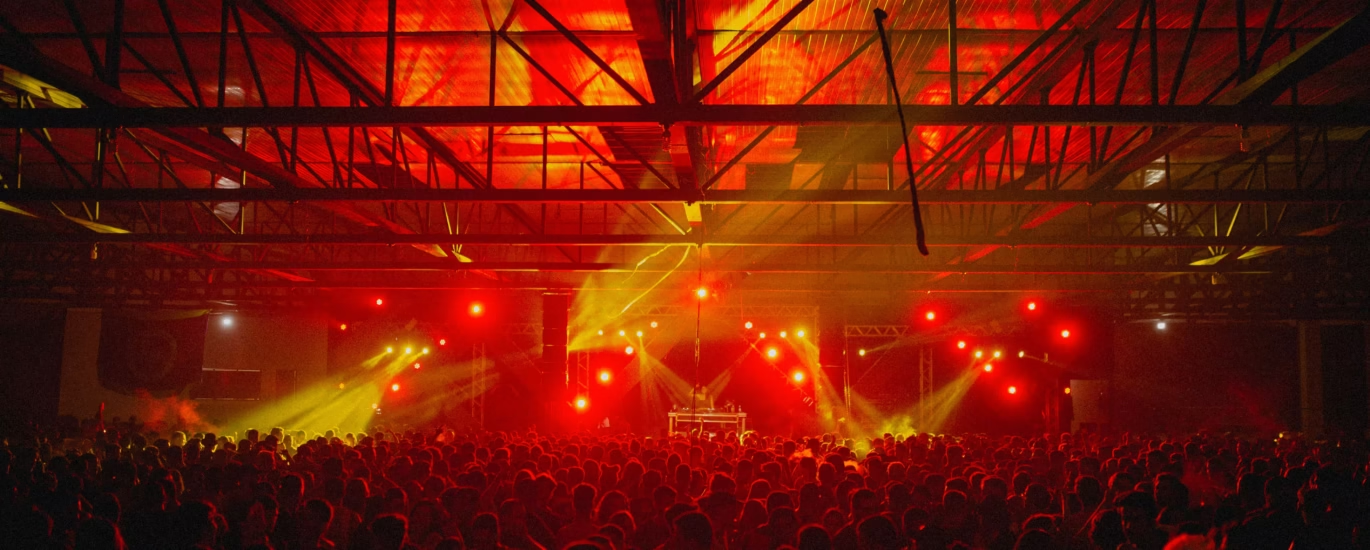
In the modern digital landscape, few electronic music genres are as instantly recognizable—visually and sonically—as Hardbass. For a massive portion of the internet, the genre is inextricably linked to a hyper-specific visual aesthetic: young men in three-stripe tracksuits and balaclavas, squatting in concrete courtyards, aggressively dancing to a blistering, bouncy beat.
Because of this intense virality and deep association with meme culture, it is easy to write Hardbass off as an internet joke created by YouTubers. However, that assumption ignores a rich, decades-long history of electronic music evolution. Long before it became the unofficial soundtrack of gaming montages and viral flash mobs, Hardbass was a legitimate, pulse-pounding underground movement born in the freezing warehouses of post-Soviet Russia.
To understand how a niche, aggressive offshoot of European house music conquered global internet culture, we have to trace its roots back to Saint Petersburg in the late 1990s. We are breaking down the definitive history of Hardbass, exploring its sonic architecture, its connection to the Gopnik subculture, and how the internet transformed it from a local club sound into a worldwide phenomenon.
The Origins (Late 1990s): Pumping House in Saint Petersburg
Following the collapse of the Soviet Union in 1991, Western electronic music—specifically techno, trance, and house—flooded across the border into Russia. By the late 1990s, Saint Petersburg had established itself as the beating heart of the Russian rave scene.
DJs and producers in the city became obsessed with a specific UK and European subgenre called “Pumping House” (closely related to Scouse House and Bouncy Techno). The defining characteristic of this music was a heavy kick drum and an aggressive, metallic, off-beat bassline.
However, the Russian crowds wanted more energy. Local DJs began pitching the European tracks up, increasing the tempo significantly past the standard 130 BPM. By the early 2000s, producers like DJ Tolstyak, DJ Snat, and the legendary duo XS Project began producing their own original tracks specifically for these massive, high-energy warehouse parties. They pushed the tempo to a relentless 150 to 175 BPM, heavily distorted the kick drums, and added aggressive Russian vocal chants.
By 2003, this mutated, hyper-aggressive version of Pumping House had officially crystallized into its own genre: Hardbass.
The Anatomy of the Sound: The Almighty “Donk”
You cannot discuss the history of Hardbass without discussing the specific sound synthesis that defines it. The genre is entirely built around a synthesized bass patch known as the “Donk.”
A donk is created using FM (Frequency Modulation) synthesis. It produces a short, percussive, hollow sound that is often compared to a wet PVC pipe or a heavy metallic tube being struck with a rubber mallet.
In a Hardbass track, a heavy, distorted 909-style kick drum hits on the downbeat (beats 1, 2, 3, and 4). The metallic “donk” bass is placed precisely on the off-beat (the empty spaces between the kicks). This rapid-fire, back-and-forth interaction at 160 BPM creates a violent, see-saw rhythm. It does not make you want to sway; it structurally forces you to bounce, jump, and stomp.
The Gopnik Connection and the Visual Aesthetic
Music never exists in a vacuum; it always attaches itself to a subculture. In the mid-2000s, Hardbass became the unofficial soundtrack of the Gopniks.
The term Gopnik emerged in post-Soviet Russia to describe working-class youth who often congregated in public parks, courtyards, and stairwells. The subculture had a very strict visual identity:
- The Tracksuit: Imported Western tracksuits (specifically Adidas, which gained massive cultural cachet in Eastern Europe following the 1980 Moscow Olympics) were the ultimate status symbol.
- The Slav Squat: A practical resting position on cold or dirty concrete floors, keeping the heels flat on the ground.
- The Accessories: Flat caps (newsboy caps), sunflower seeds, and cheap local beer or vodka.
As Hardbass grew in popularity, the Gopnik aesthetic became the genre’s permanent visual uniform. The aggressive, street-level energy of the youth perfectly matched the abrasive, high-tempo pounding of the music.
The Turning Point (2010–2011): The “Hardbass Attacks”
For its first decade, Hardbass remained a relatively localized phenomenon in Russia and Eastern Europe. That changed entirely in 2010 with the invention of the “Hardbass Attack” (often referred to as a Hardbass Flashmob).
Groups of youths—decked out in full tracksuits and balaclavas to hide their identities—would organize online and descend upon public spaces across Russia, Belarus, and Ukraine. They would flood into shopping malls, university classrooms, public squares, or subway stations with massive portable speakers. They would blast Hardbass music, perform an aggressive, synchronized stomping dance for two or three minutes, and then rapidly disperse before authorities could intervene.
These flash mobs were recorded on early smartphones and uploaded to YouTube. The juxtaposition of normal, quiet public spaces being suddenly overwhelmed by masked youths aggressively dancing to 160 BPM music was visually hypnotic. The videos went massively viral, marking the exact moment Hardbass leaped from the underground club scene into the global internet consciousness.
The Meme Era and Global Gaming Culture (2015–Present)
Once the Hardbass flash mobs hit YouTube, western internet culture adopted the genre immediately. It became the ultimate musical shorthand for anything related to Eastern Europe, high-energy chaos, or satirical aggression.
The Gaming Connection:
Hardbass found a massive, permanent home in global gaming culture. Communities surrounding games with Eastern European settings—such as S.T.A.L.K.E.R., Metro 2033, Escape from Tarkov, and Counter-Strike: Global Offensive (CS:GO)—adopted Hardbass as their anthem. YouTube gaming montages featuring high-speed gameplay were inevitably set to pounding Hardbass tracks.
The Rise of the Internet Producers:
This meme-driven virality birthed a new wave of producers who understood exactly how to bridge the gap between high-quality electronic production and internet humor.
- Creators like DJ Blyatman and Alan Aztec began producing incredibly polished, high-energy Hardbass tracks specifically tailored for the internet audience, collaborating with mega-YouTubers like Life of Boris.
- Groups like Russian Village Boys combined the raw energy of punk rock with Hardbass and Gabber, taking the sound out of the meme sphere and onto massive European festival stages.
Frequently Asked Questions (FAQ)
Understanding the Hardbass Journey
Is Hardbass related to Hardstyle?
They are separate genres but share a similar high-BPM energy. Hardstyle originated in the Netherlands, focuses on a pitched kick drum that acts as a melody, and is designed for massive theatrical festivals. Hardbass originated in Russia, uses the off-beat “donk” bass, and has rawer, street-level origins.
What is the most famous Hardbass song?
While millions of tracks exist, “Bochka, Bass, Kolbaser” by XS Project (released in the mid-2000s) is widely considered the foundational anthem of the genre. More recently, DJ Blyatman’s collaborations, such as “Gopnik” or “Slav King,” have garnered tens of millions of views globally.
Do Russian clubs still play Hardbass today?
Yes, though it has evolved. While the mainstream club scene in Moscow and Saint Petersburg is dominated by standard techno and house, Hardbass maintains a fierce, dedicated underground rave scene. Furthermore, the genre is currently experiencing a massive resurgence in Western Europe, heavily influencing modern Gabber and Hardcore sets.
The history of Hardbass is a masterclass in modern cultural evolution. It is incredibly rare for a localized, highly aggressive club sound to survive a transition into internet meme culture without completely losing its musical integrity. Yet, Hardbass managed to do exactly that.
The three-stripe tracksuits and the squatting memes introduced the genre to hundreds of millions of people who otherwise would never have listened to a 160 BPM Russian dance track. Today, the meme culture and the legitimate musical production exist in perfect symbiosis. Whether it is playing out of a portable speaker in a concrete courtyard, backing a viral gaming montage, or shaking the floorboards of a massive European festival tent, the relentless, bouncing “donk” of Hardbass continues to command the global dance floor.