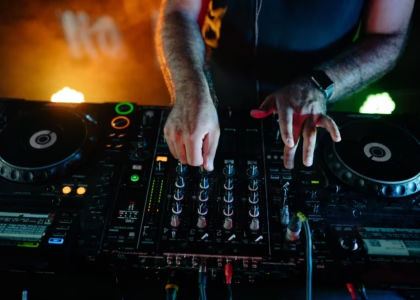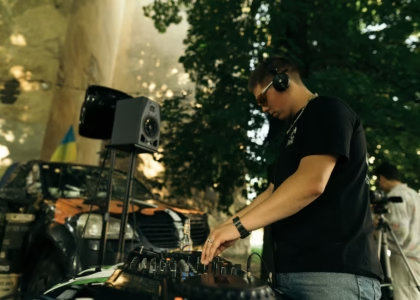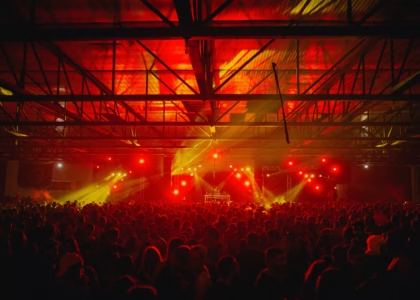

Diving into the world of Hardbass for the first time can be an overwhelming experience. If you are accustomed to standard 128 BPM house music or mainstream pop, suddenly getting hit with a 160 BPM distorted kick drum, aggressive Russian rapping, and a metallic bouncing “donk” bass can feel like absolute sonic chaos.
Because Hardbass exists at the intersection of a legitimate underground electronic dance music subculture and a massive global internet meme phenomenon, the catalog of tracks available online is staggeringly huge. If you search for Hardbass on YouTube or Spotify, you will be hit with thousands of user-generated playlists, ranging from beautifully produced festival anthems to poorly mixed, ear-piercing joke tracks.
If you want to understand why this genre commands such a dedicated global following—and why top artists like DJ Blyatman, XS Project, and Hard Bass School rack up hundreds of millions of streams—you need to start with the foundational tracks. You need the songs that define the sound design, the culture, and the unmatched bouncing energy of the genre.
Whether you are an aspiring producer trying to deconstruct the perfect FM synthesizer donk, or just a gamer looking for the ultimate high-energy playlist, this is your definitive beginner’s guide to the best Hardbass songs that define the genre.
The Pioneers: Classic Russian Hardbass
To understand where Hardbass is today, you have to hear where it started. In the early to mid-2000s, producers in Saint Petersburg took UK Pumping House, sped it up to 150+ BPM, and added raw, aggressive Russian vocals. These tracks are rough around the edges, but they established the blueprint.
XS Project – “Bochka, Bass, Kolbaser”
If there is a single song that serves as the “National Anthem” of traditional Hardbass, it is this mid-2000s classic by XS Project. The title translates roughly to “Kick drum, bass, and the raver” (a kolbaser is Russian slang for someone who parties aggressively to electronic music).
- Why it defines the genre: This track is a masterclass in the foundational “off-beat” rhythm. It isolates the heavy 909 kick drum on the downbeat and perfectly places the hollow, metallic “donk” bass on the off-beat. It is raw, repetitive, and entirely engineered to force a crowd to jump. XS Project remains one of the most prominent legacy acts in the genre today.
DJ Snat – “Gop FM”
Before the internet meme explosion, Hardbass was the music of the Gopniks—the post-Soviet working-class youth who famously wore tracksuits and squatted in concrete courtyards. “Gop FM” captures that specific era perfectly.
- Why it defines the genre: It features a slightly slower tempo (around 150 BPM) compared to modern tracks, showcasing the direct evolutionary link between 1990s European Bouncy Techno and modern Hardbass. The vocal samples act more like a percussion instrument than a melody, setting the standard for how vocals are treated in the genre.
The Viral Meme Era: The Internet Explosion
In the early 2010s, Hardbass leapt from the Russian underground into the global internet consciousness via “Hardbass Attack” flashmobs on YouTube. This era introduced satirical, humorous elements to the music, blending high-quality production with tongue-in-cheek internet culture.
Hard Bass School – “Narkotik Kal”
Released during the height of the flashmob era, “Narkotik Kal” (which translates to “Narcotics are Rubbish”) was initially intended as a satirical anti-drug anthem promoting sports and dancing instead of substance abuse.
- Why it defines the genre: It is arguably one of the most recognizable Hardbass tracks in the world. The bouncing bassline is iconic, and the music video—featuring tracksuited youth dancing aggressively on playgrounds—permanently cemented the visual aesthetic of the genre for a global audience. Hard Bass School remains a massive pillar of the community.
DJ Blyatman & Life of Boris – “Slav King”
When top-tier electronic production met a massive YouTube gaming personality (Life of Boris), the result was “Slav King.” Slovakian producer DJ Blyatman is widely considered the king of the modern internet Hardbass era, consistently generating millions of monthly listeners.
- Why it defines the genre: This track represents the “crossover” peak of Hardbass. The production quality is pristine, featuring modern digital distortion, aggressive sidechaining, and perfectly mixed vocals. It proves that a track can lean heavily into internet meme culture (referencing tracksuits, kvass, and squatting) while maintaining incredibly high-level audio engineering.
The Modern Evolution: Festival, Gaming, and Crossover Hardbass
Today, Hardbass is no longer strictly bound by its original Russian roots. Producers from the UK, Latvia, and across Europe are pushing the BPM higher, integrating elements of Hardstyle, Gabber, and video game music to create a truly global sound.
Alan Aztec – “Papa Carlo” (or “Stalingrad”)
Hailing from the United Kingdom, Alan Aztec has carved out a massive niche by blending Hardbass with video game culture, historical themes, and blistering speeds.
- Why it defines the genre: Tracks by Alan Aztec often push the tempo past 165 BPM. He frequently incorporates fast-paced accordion melodies, hardstyle-influenced synth leads, and a heavier, more distorted kick drum. His style is the ultimate soundtrack for competitive, high-adrenaline gaming sessions.
Uamee – “Kvas”
Latvian producer Uamee is a master of blending the classic metallic donk with modern electronic music elements.
- Why it defines the genre: “Kvas” perfectly highlights the instrumental, melodic side of modern Hardbass. While the classic tracks rely heavily on shouted vocal chants, Uamee often builds driving, infectious synthesizer melodies that sit perfectly over the 160 BPM bounce, proving that the genre can be deeply musical.
Russian Village Boys – “Insta Girl”
If you want to know what Hardbass sounds like when it is performed live on a massive European festival stage, you listen to Russian Village Boys.
- Why it defines the genre: They inject the raw, rebellious energy of punk rock into the Hardbass formula. Their tracks are chaotic, incredibly loud, and often cross the border into Hardcore and Gabber territory. They represent the modern rave evolution of the genre, designed to destroy massive festival sound systems.
How to Listen to Hardbass: A Beginner’s Guide
If you are queuing up these tracks for the first time, you need to adjust your listening expectations. Here is how to appreciate the organized chaos:
- Focus on the Off-Beat: Don’t try to nod your head to the heavy kick drum on the downbeat. Instead, listen for the metallic “donk” sound hitting immediately after the kick. Your brain should lock onto the bouncing, see-saw interaction between the two sounds.
- Accept the Satire: Hardbass does not take itself seriously, and neither should you. The aggressive shouting is part of the instrumentals. Embrace the humor, the tracksuits, and the chaotic energy.
- Use the Right Audio Gear: You cannot appreciate Hardbass through a cheap phone speaker. Because the genre relies on heavy sidechain compression separating the sub-bass from the metallic donk, you need good studio headphones or a sound system with a dedicated subwoofer. If you don’t feel the physical impact of the kick, you are missing half the experience.
The beauty of Hardbass lies in its unapologetic intensity. What started as a localized, underground experiment in Saint Petersburg has fractured into a massive, multi-faceted global genre.
If you want the raw, authentic history, start with XS Project. If you want the viral, polished internet anthems, queue up DJ Blyatman. And if you are looking for the ultimate high-speed gaming soundtrack, Alan Aztec and Uamee are waiting for you. By exploring these foundational and modern tracks, you will quickly understand why that bouncing 160 BPM rhythm has permanently conquered the internet and the global dance floor.