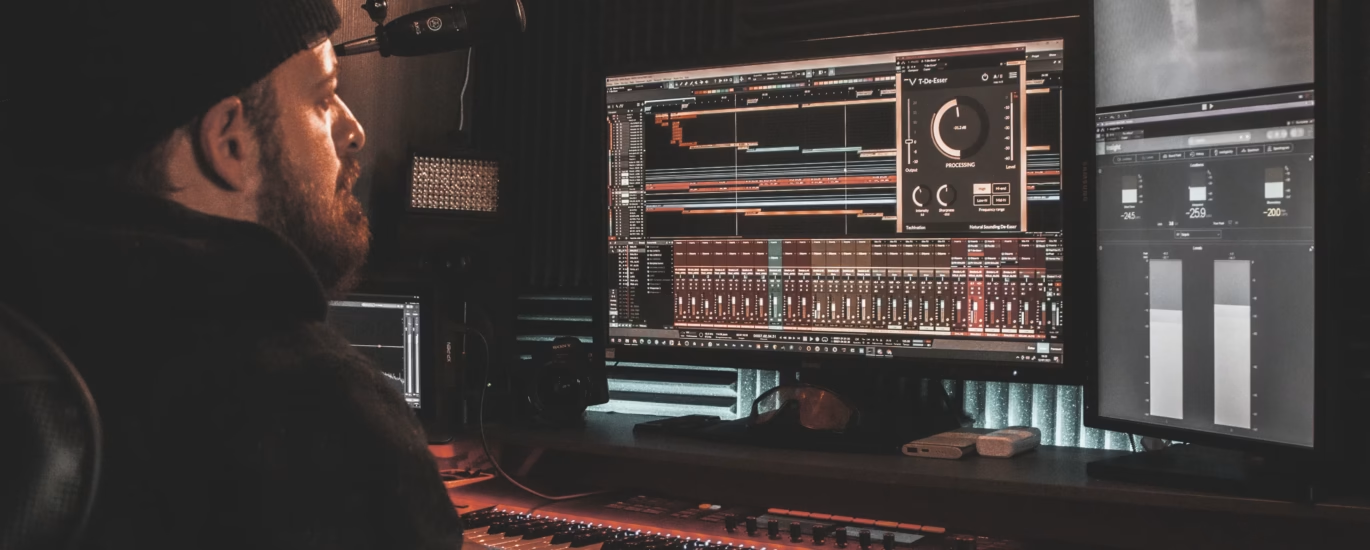
When you watch studio tutorials from top-tier Hardstyle or Hardbass producers, their screens are usually filled with premium plugins. It is incredibly easy to look at a 160 BPM project file and assume that unless you drop $199 on Xfer Serum for your FM synthesis, $150 on FabFilter Saturn for your distortion, and another $200 on a dynamic equalizer, you simply cannot achieve that aggressive, professional, club-ready sound.
This assumption is completely false. While premium plugins often offer streamlined visual workflows and dedicated customer support, the underlying mathematical algorithms of audio synthesis, clipping, and distortion are universal. Over the past several years, the independent software developer community has released a massive wave of open-source and freeware Virtual Studio Technology (VST) plugins that rival—and in some niche use-cases, completely outperform—their expensive commercial counterparts.
If you are producing hard dance music, you do not need a bloated library of orchestral strings or realistic grand pianos. You only need three core elements to build a track: an aggressive synthesizer for your “donk” and “screech” leads, extreme distortion to musically destroy your 909 kick drums, and precise dynamic control to sidechain the chaos. Here is the definitive, comprehensive guide to the absolute best free VST plugins to build your Hardbass and Hardstyle toolkit from scratch.
What Hard Dance Sound Design Actually Demands
Before blindly downloading plugins, you must understand exactly what the Hardbass and Hardstyle genres require from a technical standpoint.
Producing at 150 to 175 BPM leaves very little room for error. The gap between a kick drum hitting on the downbeat and a metallic bass hitting on the off-beat is less than 200 milliseconds. If your plugins introduce latency, or if your synthesizers have sloppy, slow envelope attacks, the bouncing groove will instantly collapse into a muddy wall of noise.
You need plugins capable of generating harsh, mathematically complex waveforms (like Frequency Modulation and Wavetable synthesis). You need saturation tools that can add heavy grit to a low-frequency sub-bass without causing phase cancellation. Most importantly, you need visual feedback. When dealing with extreme digital distortion, being able to see how a plugin is warping your audio waveform is just as critical as hearing it.
The Heavyweight Synthesizers: Designing Donks and Leads
Hard dance music relies on complex, metallic, and harsh digital synthesis. These three free synthesizers are all you need to design world-class basslines and leads.
Vital (by Matt Tytel)
Vital is arguably the most powerful free synthesizer ever created for electronic music. It is a visual wavetable synthesizer that operates almost identically to the industry-standard Xfer Serum, but it is available for free. The user interface is completely animated, showing you exactly how your waveforms, filters, and envelopes are warping in real-time.
- For Hardstyle: The built-in unison engines allow you to detune multiple voices effortlessly, creating massive, wide “screech” leads that cut through heavy mixes.
- For Hardbass: Vital features incredibly fast, drag-and-drop FM (Frequency Modulation) routing. You can quickly map a sine wave to modulate a square wave, attach a fast-decay pitch envelope (ADSR) to the oscillators, and dial in the perfect, rubbery, metallic donk bass in a matter of seconds.
Surge XT
Surge XT is open-source, community-driven, and incredibly deep. While its user interface looks a bit more clinical and complex than Vital, it is an absolute monster for hard dance layers. It features dual synthesis engines (Scene A and Scene B), meaning you can layer a deep FM sub-bass and a heavily distorted wavetable lead within a single VST instance. It is highly CPU-efficient and comes with a massive library of community-designed presets if you want to reverse-engineer how complex hard dance basses are constructed.
Dexed
If you want the most authentic, old-school 2005 Hardbass donk, you need FM synthesis from that exact era. Dexed is a perfect software clone of the legendary Yamaha DX7 hardware synthesizer (the machine responsible for shaping 1980s pop and 1990s dance music). Dexed is not the easiest synth to program due to its classic algorithm matrix. However, it can load thousands of original DX7 SysEx preset cartridges (which are easily found for free online). Loading a traditional “Solid Bass” DX7 patch instantly gives you the raw, unpolished, hollow FM sound that birthed the Russian underground rave scene.
Distortion and Waveshaping: Carving the Aggressive Kick
A clean 909 kick drum sample sounds like a polite, dull thud. To turn it into a Hardbass weapon, you have to destroy it musically. Distortion adds high-frequency harmonics, turning a dull kick into a roaring, aggressive punch.
CamelCrusher (by Camel Audio)
This plugin is the holy grail of hard dance distortion. While Camel Audio was bought by Apple years ago (meaning the plugin is technically “abandonware”), it remains widely available for free across production forums. It features a simple interface with two distortion types (“Tube” for warmth and “Mech” for destruction) and an aggressively pumping built-in compressor. Putting a standard kick drum through the “Tube” circuit and driving the “Compress” knob instantly gives it the gritty, overdriven thump required for Hardbass.
Misstortion (by Nimble Tools)
Misstortion was built specifically by and for Hardstyle producers. Hardstyle kicks are notoriously difficult to synthesize because you have to distort the kick heavily without completely ruining the low-end sub-frequencies. Misstortion offers asymmetrical clipping and precise internal filtering. This allows you to crunch the top-end “tok” of the kick drum into oblivion while keeping the booming bass tail completely clean and powerful.
Klanghelm IVGI
For a slightly more subtle approach, IVGI is a phenomenal free saturation plugin. When you have synthesized your FM donk in Vital but it sounds too “digital,” sterile, or cold, running it through IVGI adds analog-style console warmth. It reacts dynamically to the incoming signal, adding subtle grit that makes digital basslines sit much thicker in a crowded mix.
Mixing, Dynamics, and Utility: Sculpting the 160 BPM Bounce
When you have a massively distorted kick and a metallic bass firing back and forth at 160 BPM, your mix will turn into a muddy frequency clash if you do not control the dynamics.
TDR Nova (by Tokyo Dawn Records)
Standard equalizers cut a frequency permanently. TDR Nova is a free parallel dynamic equalizer. A dynamic EQ only cuts a frequency when it gets too loud. This is absolutely critical in Hardstyle and Hardbass: you can set Nova to only compress the harsh 3kHz range of your synth screeches exactly when they peak. This prevents the harsh white noise from piercing the listener’s ears and causing fatigue, without permanently dulling the energy of the track.
Flux Mini 2 (by Caelum Audio)
The premium plugin Kickstart is the industry standard for instant volume-ducking sidechain, but Flux Mini 2 does it entirely for free. You draw a volume curve on a grid, and it automatically ducks the volume of your bassline every time the kick drum hits on the downbeat. This tool is mandatory for creating the bouncy, see-saw rhythm of Hardbass without spending hours manually tweaking standard compressor threshold knobs.
Venn Audio Free Clip
As you layer distortion upon distortion, the volume peaks of your kick drums will spike out of control. Free Clip is an excellent soft clipper. Place it on your drum bus to shave off the absolute highest transient peaks of your kick drums. It rounds off the audio peaks (adding a pleasant saturation) while buying you valuable headroom, allowing you to push your master limiter harder and make your track competitively loud.
Step-by-Step: Building a Free Hardbass Signal Chain
To prove how capable these free tools are, here is exactly how you can build a professional Hardbass donk channel strip in your DAW without spending a dime:
- The Sound Source: Open an instance of Vital. Load a sine wave on Oscillator 1 (Carrier) and a sine wave on Oscillator 2 (Modulator). Route Osc 2 to frequency modulate (FM) Osc 1.
- The Envelope: In Vital, set the Envelope 1 (Volume) to a zero attack and a very fast decay (around 300ms). Create a second envelope with an even faster decay (50ms) and route it to the global pitch. This creates the rubbery “laser” bounce.
- The Grit: Add Klanghelm IVGI directly after Vital in your mixer rack. Turn up the drive slightly to warm up the digital sine waves.
- The Bounce: Add Flux Mini 2 at the end of the chain. Draw a steep volume curve that drops to zero on the downbeat (when your kick drum hits) and aggressively sweeps back up on the off-beat, creating perfect sidechain pumping.
Hardware & Performance Considerations
While these plugins are free, they are incredibly mathematically dense. Visual synthesizers like Vital and oversampled clippers like Free Clip will heavily tax your computer’s CPU. For a seamless production experience without audio stuttering or dropouts, ensure your computer features a modern processor (such as an Intel Core i5 or AMD Ryzen 5 series) paired with at least 16 GB of RAM. Furthermore, utilizing a 2K monitor is highly recommended so you can keep your DAW’s piano roll open while simultaneously tweaking the visual interface of Vital.
Frequently Asked Questions (FAQ)
Are free VST plugins safe to download?
Yes, provided you download them directly from the developer’s official website or reputable plugin directories like Plugin Boutique or KVR Audio. Avoid downloading “cracked” or bundled freeware from unknown forum links, as they can occasionally harbor malware.
Do these free plugins work on both Mac and Windows?
The vast majority of the plugins listed (including Vital, Surge XT, TDR Nova, and Flux Mini 2) are fully cross-platform and available in VST3, AU (Audio Unit for Mac/Logic Pro), and AAX formats. Note: CamelCrusher is older and may require a 32-bit to 64-bit bridge on modern macOS systems like Apple Silicon.
Can I use these plugins to make Rawstyle or Frenchcore?
Absolutely. The foundational techniques of hard dance synthesis apply across all subgenres. By increasing the BPM in your DAW to 200, applying heavier settings in Misstortion, and utilizing deeper wavetables in Vital, you can easily shift from bouncy Hardbass to aggressive Rawstyle or Frenchcore.
The defining tracks of the early Hardbass and Hardstyle movements were not produced in million-dollar studios. They were built on cheap software, heavy experimentation, and ruthless digital distortion in freezing bedrooms across Europe.
Downloading Vital, CamelCrusher, and Flux Mini 2 gives you the exact same synthesis capabilities, distortion algorithms, and dynamic control as the producers headlining massive European hard dance festivals. The tools are completely free and widely available; the only thing separating your current track from a mainstage anthem is the time you dedicate to twisting the knobs and training your ears.