When you listen to Hardbass, the very first thing that hits you—before the aggressive Russian chants or the iconic “donk” bass—is the sheer speed of the music. It feels relentless, driving, and physically demanding.
In electronic dance music, BPM (Beats Per Minute) is not just a measurement of time; it is the structural foundation that dictates the genre. A track played at 125 BPM makes you want to sway; a track played at 160 BPM forces you to jump. The tempo dictates how much space exists between the drum hits, which in turn completely changes how producers synthesize their instruments and how a crowd physically reacts on the dance floor.
Hardbass occupies a very specific, hyper-energetic speed bracket. It is fast enough to incite absolute chaos, but controlled enough to maintain a deeply infectious groove. Whether you are an aspiring producer trying to set your project tempo or a DJ looking to mix Hardbass into a multi-genre set, understanding the exact BPM mechanics of the genre is essential. We are breaking down the typical Hardbass tempos, the physics of the “bounce,” and how speed shapes the entire sound.
The Hardbass Speed Zone (150 to 175 BPM)
While early precursors to the genre in the late 1990s occasionally dipped into the 140 BPM range, modern Hardbass is firmly anchored between 150 and 175 BPM.
This 25-BPM window can be broken down into three distinct energy tiers:
- 150 – 155 BPM (The Classic Groove): This is the speed of early 2000s Pumping House and classic Saint Petersburg Hardbass. At 150 BPM, the track retains a strong, “groovy” house music feel. It is fast, but there is still enough breathing room between the kicks for longer, more rhythmic vocal samples and slightly sustained basslines.
- 155 – 165 BPM (The Modern Sweet Spot): This is where 90% of viral, modern Hardbass lives. Artists like DJ Blyatman and XS Project frequently target 160 BPM. At this speed, the energy becomes incredibly aggressive. The bounce is tight and violent, perfectly matching the frenetic, synchronized stomping associated with the genre’s internet meme culture.
- 165 – 175+ BPM (The Gabber Crossover): When Hardbass breaches 170 BPM, it begins blurring the lines with Gabber and UK Hardcore. The bounce becomes almost too fast to physically jump to, turning into a frantic sprint. Producers like Alan Aztec often push into this territory for maximum adrenaline.
The Physics of the Bounce at 160 BPM
To understand why Hardbass feels so physically demanding, you have to look at the math behind the BPM.
At exactly 160 BPM, there is only 375 milliseconds between each kick drum hit. Hardbass is famous for its “off-beat donk” (a metallic bass hit placed exactly halfway between the kicks). This means the time between the heavy kick (the downbeat) and the donk (the up-bounce) is roughly 187 milliseconds.
This incredibly rapid alternation creates a see-saw effect in your brain. You hear the heavy kick and your body drops; you hear the hollow donk 187 milliseconds later and your body lifts. Because this cycle repeats 160 times every minute, your body is physically forced into the aggressive, rapid-fire squatting and jumping that defines Hardbass rave culture.
How High Tempos Dictate Sound Design
You cannot just take a 128 BPM House track, speed it up to 160 BPM, and call it Hardbass. The speed dictates the sound design. Because there is so little time between beats, producers have to engineer their sounds specifically to avoid turning the track into a muddy, blurry mess.
- Zero Release / Fast Decay: The synthesizer playing the donk bass must be programmed with an incredibly short envelope. The sound must trigger instantly and cut off instantly. If the donk has a long “tail” or sustain, it will bleed into the next kick drum, completely destroying the bouncy groove.
- No Long Reverbs: In slower genres like Techno or Trance, producers use massive, cavernous reverbs to make the track sound huge. In Hardbass, heavy reverb on the bass or kick is strictly forbidden. The reverb tail would wash out the empty space between the beats, killing the high-speed rhythm.
- Aggressive Sidechaining: To ensure the kick and bass never collide at high speeds, producers use heavy sidechain compression. The millisecond the kick hits, the volume of all other instruments instantly drops, ensuring the 160 BPM rhythm remains surgically precise.
BPM Comparison: The Electronic Music Spectrum
To put the speed of Hardbass into context, here is where it sits compared to the rest of the electronic dance music spectrum:
| Genre | Typical BPM Range | Rhythmic Feel |
| Deep House | 120 – 125 BPM | Relaxed, swaying, continuous groove. |
| Techno | 130 – 140 BPM | Driving, hypnotic, steady march. |
| Dubstep | 140 – 150 BPM (Half-time) | Heavy, dragging, head-banging (snare hits on beat 3). |
| Hardstyle | 150 – 160 BPM | Grand, marching, anthemic. |
| Hardbass | 150 – 175 BPM | Frantic, bouncy, jumping off-beat rhythm. |
| Frenchcore | 190 – 220+ BPM | Relentless, extreme speed, continuous vibration. |
The DJ’s Challenge: Mixing at Extreme Speeds
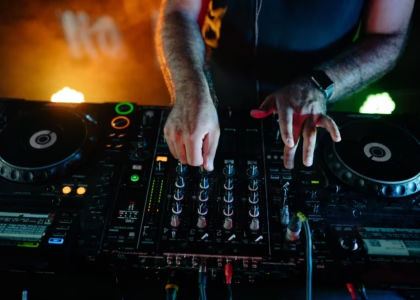
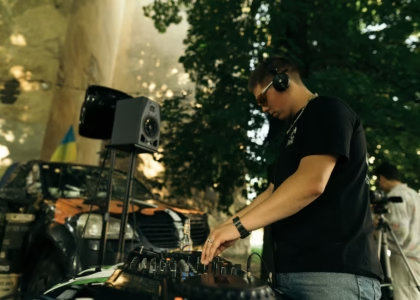
For DJs, playing a Hardbass set presents a unique physical and technical challenge. Mixing at 160 BPM requires fast hands.
Because the tracks are so fast, the intro and outro phrasing (usually 16 or 32 bars) passes by incredibly quickly. A DJ has half the time to beatmatch and EQ a transition compared to a standard House DJ. Furthermore, a DJ must carefully manage the crowd’s energy. Forcing a crowd to jump at 165 BPM for an hour straight leads to physical exhaustion. Skilled Hardbass DJs will frequently create “valleys” in their sets—dropping the tempo slightly to 150 BPM or letting atmospheric, vocal breakdowns play out fully—to give the ravers a chance to catch their breath before slamming the tempo back up.
Frequently Asked Questions (FAQ)
Can Hardbass be produced slower than 150 BPM?
Technically yes, but it fundamentally changes the genre. If you drop a classic Hardbass track down to 130 BPM, it loses its frantic “bounce” and immediately reverts to sounding like standard UK Scouse House or late-90s Bouncy Techno. The extreme speed is a required ingredient for the Hardbass identity.
Why do some modern Hardbass tracks feel slower?
Some crossover tracks rely on “half-time” breakdowns (similar to Trap or Dubstep) where the kick drum hits half as often, even though the master project BPM remains at 160. This creates a massive, heavy groove for a few bars before the frantic four-on-the-floor beat returns.
Is it hard to mix Hardbass with other genres?
Yes, due to the extreme tempo gap. If a DJ wants to transition from a 128 BPM Bass House track into a 160 BPM Hardbass track, they cannot simply use the pitch slider (which would distort the song heavily). They usually rely on tempo-changing transition tracks, sudden echo-outs, or heavy breakdown mixing to bridge the massive BPM gap.
The defining characteristic of Hardbass isn’t just the tracksuits or the metallic synthesizers—it is the unrelenting, driving speed of the music. By anchoring the genre firmly in the 150 to 175 BPM range, producers engineered a sound that physically commands movement. The short, punchy sound design and the perfectly calculated milliseconds between the kick and the donk create an infectious, violent bounce that slower genres simply cannot replicate.
Whether you are producing in a DAW or sweating on a festival dance floor, understanding the raw mathematics of the Hardbass BPM reveals exactly why this Russian underground sound became a global dance phenomenon.