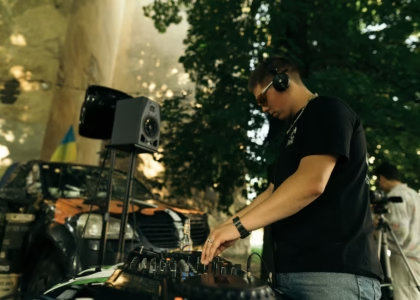

If you have ever listened to a high-speed electronic dance track and heard a bassline that sounds suspiciously like someone hitting a wet PVC pipe with a rubber mallet, you have encountered the Donk.
To the uninitiated, the “donk” bass can sound comical—a hollow, metallic, rubbery thud that seems out of place in aggressive, fast-paced dance music. Yet, this highly specific synthesizer patch is the undisputed heartbeat of several massive electronic subcultures, most notably Hardbass and UK Scouse House. It is the sonic engine that forces festival crowds and underground ravers into a synchronized, relentless bounce.
While the donk has spawned countless internet memes (from tracksuited flash mobs to gaming montages), its creation is a masterclass in aggressive sound design. Understanding the donk means looking under the hood of Frequency Modulation (FM) synthesis to see exactly how producers turn simple digital waves into a club-shaking weapon. We are breaking down the history, the rhythmic science, and the technical anatomy of the signature sound of Hardbass.
The Origins of the Donk
While the donk is globally recognized today as the defining characteristic of Russian Hardbass, its true origins lie further west in the United Kingdom and Western Europe.
In the late 1990s and early 2000s, producers in the North West of England were experimenting with a genre known as Scouse House (or Bouncy Techno). Local legends like the Blackout Crew and DJ KB Project popularized a high-tempo, energetic club sound built around a bouncy, percussive bassline. The sound was affectionately dubbed a “donk” because of its literal onomatopoeic quality—it sounded like donk, donk, donk.
Around the same time, this infectious rhythm migrated to Saint Petersburg, Russia. Russian producers took the UK blueprint, stripped away the happy, uplifting vocals, increased the tempo to a blistering 150-175 BPM, and applied massive amounts of distortion to the kick drums. This aggressive, hyper-fast mutation became Hardbass, and the donk was cemented as its primary driving force.
The Science of the Sound: FM Synthesis Explained
You cannot create a proper donk using standard analog subtractive synthesis (like a classic Moog synthesizer). The donk relies entirely on the complex, metallic harmonics generated by Frequency Modulation (FM) synthesis.
In the early 2000s, producers created this sound using hardware like the Yamaha DX7. Today, it is almost exclusively produced in digital audio workstations (DAWs) using modern FM VST plugins like Xfer Serum, Ableton Operator, or Native Instruments FM8.
Here is exactly how a donk is engineered:
- The Carrier and the Modulator: FM synthesis works by having one waveform (the Modulator) rapidly alter the frequency of another waveform (the Carrier). To make a donk, producers usually start with a simple Sine or Triangle wave as the Carrier. They then use a second Sine wave (pitched an octave or two higher) to modulate it aggressively. This rapid modulation creates the sharp, hollow, metallic timbre.
- The Pluck Envelope (ADSR): A donk is not a sustained bass note; it is highly percussive. Producers set the synthesizer’s amplitude envelope with a zero attack (instant volume), a very fast decay, and zero sustain. This creates a sharp “pluck” that hits hard and disappears instantly.
- Pitch Envelope (The “Laser” Effect): To give the donk its bouncy, rubbery feel, a rapid pitch-drop envelope is applied to the very beginning of the note. The pitch starts high and drops to the root note in a fraction of a second (often less than 50 milliseconds), mimicking the physics of striking a tight drum membrane.
The Rhythmic Function: Why It Makes You Bounce
The brilliance of the donk in Hardbass is not just how it sounds, but where it is placed in the musical measure. Hardbass structurally separates the kick drum and the bassline into two distinct, alternating entities.
The kick drum (usually a heavily distorted Roland TR-909 sample) hits squarely on the downbeat: 1 . 2 . 3 . 4.
The donk bass is programmed to hit exclusively on the off-beat (the exact spaces between the kicks): 1 and 2 and 3 and 4 and.
This arrangement is known as the “off-beat bass” pattern. Because the heavy, sub-heavy kick drum and the higher, metallic donk never play at the exact same millisecond, they do not clash in the frequency spectrum. Instead, they create a violent, see-saw pumping rhythm. The listener’s brain registers the heavy kick as the “down” motion and the metallic donk as the “up” motion, physically compelling the crowd to jump, bounce, or stomp in a synchronized rhythm.
Evolving the Donk: Modern Production Techniques
While the classic 2005 Hardbass donk was relatively clean and hollow, modern producers like DJ Blyatman, Alan Aztec, and XS Project have pushed the sound design into extreme new territories.
- Distortion and Saturation: Modern donks are rarely left clean. Producers route the FM synth through aggressive digital distortion plugins (like CamelCrusher or FabFilter Saturn) to give the metallic pluck a harsh, gritty texture that cuts through massive festival sound systems.
- Layering: To ensure the bass hits hard in a modern club, producers will often layer the FM donk with a pure, unmodulated sub-bass (a low sine wave playing underneath). The FM layer provides the recognizable “click” and metallic character in the mid-frequencies, while the hidden sub-bass provides the physical chest-rattling low end.
- Compression: Aggressive sidechain compression is applied to the donk, forcing its volume to duck slightly for a millisecond whenever the kick drum hits, ensuring the rhythm remains perfectly clean and bouncy even at 165 BPM.
Frequently Asked Questions (FAQ)
Understanding Hardbass Sound Design
Can I make a donk with a standard subtractive synthesizer?
You can get close, but it will never sound entirely authentic. You can use a square or pulse wave with a fast filter decay on a subtractive synth to make a “plucky” bass, but without Frequency Modulation (FM), you cannot generate the complex, hollow, metallic overtones that define a true donk.
What is the difference between a Hardbass Donk and a Hardstyle Kick?
They are fundamentally different. Hardbass keeps the kick drum and the donk bass as two separate instruments playing an alternating, bouncing rhythm. Hardstyle combines them; producers distort a kick drum so heavily that it generates a long, resonant tail, and they pitch that tail up and down to act as both the kick and the bassline simultaneously.
Why is the donk so heavily associated with meme culture?
The sound’s massive viral popularity stems from early 2010s “Hardbass Flashmobs” organized by Eastern European youths in tracksuits, which exploded on YouTube. The comical, rubbery nature of the donk perfectly matched the chaotic, tongue-in-cheek energy of internet gaming montages and the satirical Gopnik subculture, cementing its status as an internet legend.
The donk bass is a paradox. On its own, it sounds like a cartoon sound effect—a rubbery, metallic thud that seems entirely unserious. Yet, when placed on the off-beat behind a distorted 160 BPM kick drum, it transforms into one of the most effective, adrenaline-pumping rhythmic engines in electronic music history. By mastering FM synthesis and embracing the chaotic energy of the rave scene, producers have turned the donk into a global phenomenon, proving that sometimes, the strangest sounds make for the best dance floors.